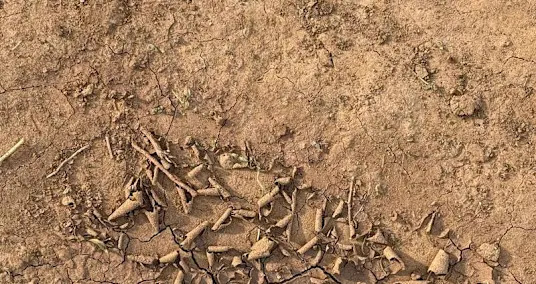
Some raindrops have fallen in the drought-ridden Turkana region in northern Kenya in recent days. But will the water keep coming, feeding the livestock of the nomadic communities and the fields of local farmers? Or will it be, once again, too little too late, resulting in hunger and loss of livelihood?
A group of elders has gathered in the bush, sitting under a thorny acacia tree. A young man uses a machete to hack green twigs from nearby bushes, later forming a circle of green with a heap of green in the middle.
The men fall silent as Lochuch Puluk Lotukoi steps into the circle of green, starting a prayer in the local Turkana language. He gestures with a wooden stick, which marks both his age and his dignified position in the community. Lotukoi asks the gods to prevent evil from coming to the community and to give him a clear vision in the ceremony to come.
Lotukoi is an elder, but he is also an emuron - a seer or prophet. This makes him the man who is essential for a ceremony called akiteyen, a traditional forecast of future events, including the weather. The Turkana believe that the power of the emuron is passed within the family from father to son or grandson.
Tall, with piercing eyes and a lean face, Lotukoi wraps his checkered black and red cloak around him as he begins a slow dance as another man leads a goat into the circle and lies the animal onto the small green platform at the centre.
The goat remains calm and hardly twitches when Lotukoi raises a knife over the animal and plunges it into its heart. There is not even much blood, not even as he slowly cuts open the belly of the dead goat.
For the Turkana, the secrets of the universe and their world lie, quite literally, in the guts of a goat or sheep - animals that are central to their livelihoods.
After removing the intestines, Lotukoi leans over the organs and stares at them, deep in concentration. The other elders gather around him and join muffled discussions.
The men point at outlines and colourings of the intestines, exchanging murmured remarks and discussing the "readings" until they feel they have reached a solid conclusion.
Members of the local county office and a meteorologist watch the age-old ritual silently, as curious about the outcome as the gathered Turkana.
When Lotukoi starts to speak, there is a sense of relief, as he has good news to announce: "Rain will come!," he says with a satisfied smile. "There will be a lot of rain, coming from Uganda." He points to a line of hills in the distance, marking the border with the neighbouring country.
Sternly he reminds the young men that it will be a good move to transfer the herds and the families' camps to upper ground to be save from eventual flooding.
Alan Kiptoch, meteorologist of the Kenyan Weather Service in Lodwar, the biggest town in Turkana, checks Lotukois forecast against the data collected by scientists.
"I have no idea how they do it - but their forecast is usually 100% correct," he says. Both the news about the intensity of the coming rains and the area they will come from correlate with the more scientific forecasts.
"Aikiru" or rain is a cherished word for the people in a region that has been hard hit by recurring droughts. Turkana has always been an arid area, but climate change has hit the nomadic societies hard.
"I first noticed things were changing in 1999," Lotukoi says after the ceremony. One of the worst droughts he experienced was in 2022, when the rainfall came too early, the grass quickly dried up and most of the livestock died. "We see the rain patterns changing," Lotukoi says.
Does he ever try to soften bad news when he reads the intestines of a goat? Lotukoi shakes his head. "We will not interfere," he says earnestly. "Whatever happens, we will say it, and accept the will of the gods."
The Turkana have developed coping mechanisms - when the forecast announces another drought, the young men of the community take most of the livestock into Uganda to graze there until they get news that it is safe to return to the rest of the community.
This way, at least part of their livelihood can be kept alive while the old men and women try to make money by producing charcoal to buy food for the remaining herd, which offers milk and meat for the families.
"But it is the harshest thing in life when you are permanently worried about your child being far away," Lochor Kaliba, one of the elders, says. He matches his traditional woven hat and woven cloak with dark sunglasses and a camouflaged jacket.
It is not just the distance that worries him. In the wild north of Kenya and in the Northern Reift Valley, intercommunal clashes over grazing grounds and cattle occur quite frequently. In the old days, cattle wars were led with spears or bows and arrows. Nowadays, firearms and automatic guns lead to bloody conflicts and far more fatalities.
While the communities in the Karamoja region in north-eastern Uganda share a similar language and origin with the Turkana, competition over water and grazing land can easily lead to conflict.
"This is why we are organizing cross border peace councils when the emuron suggests to take the herds into Uganda," says Samuel Ikeny from the climate change programme of the local council. The administrations on both sides to establish rules to ensure a peaceful neighbourhood of the different nomadic communities until, hopefully, the Turkana can bring their herds back home into Kenya.


latest_posts
- 1
 New York to require social media platforms to display mental health warnings
 - 2Portable Installment Answers for Independent ventures
- 3Make your choice for the sweet that transports you to its nation of beginning!
- 4Cyber Monday Paramount+ deal: Save 50% and stream these buzzy Taylor Sheridan shows
- 5Eco-Accommodating Kitchen Machines: 4 Picks for a Manageable Home


- ONE returns to Red Sea with new service
- An Aide On Upgrading Your FICO rating
- Zelensky names spy chief to head presidential office after corruption row
- Best Internet based Course for Learning Another Dialect: Which Stage Do You Like?
- Solid Living Tips: Experiences from a Wellness Fan
- From ‘Project Hail Mary’ to Artemis II, spaceflight captures audiences when it centers on people because human space travel is hazardous
- The Most Famous Virtual Entertainment Powerhouses of the Year
- Influencers are selling a delusional fantasy of being postpartum. Why is it so easy to believe?
- Posts falsely claim Malaysian minister to relocate public hospital for temple