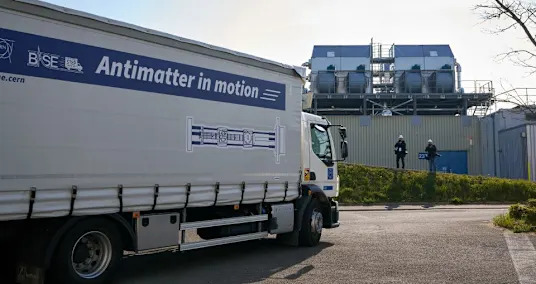
A small amount of antimatter took to the road on Tuesday, representing the first time any quantity of the world’s most expensive, volatile and rare substance has been moved. The breakthrough opens the door to new possibilities for the study of the elusive material.
Antimatter is the mirror image of regular matter — it has an opposite electric charge and reversed subatomic properties. When matter and antimatter come into contact, they annihilate each other and disappear in a flash of energy. As a result, antimatter is at the core of one of the universe’s greatest mysteries: The big bang should have created equal amounts of matter and antimatter, leading to either a universe with no matter left at all due to total annihilation, or a universe with equal amounts of both.
The universe, however, consists of matter but almost no antimatter, which exists naturally only in small quantities, created by radioactive decay and cosmic ray collisions. Physicists call this problem the matter-antimatter asymmetry. The current theory is that matter was created slightly in excess compared with antimatter — just one extra matter particle per roughly 1 billion antimatter particles — although the reason is unknown.
Studying antimatter can help scientists understand the nature of this asymmetry, but doing so isn’t easy. The instruments used to make antimatter create interference that hinders its study. Transporting antimatter away from this interference would allow scientists to take measurements of the substance more accurately.

“You need to think of these measurements as being, in some sense, similar to microscopy,” said Stefan Ulmer, a physicist at the European Organization for Nuclear Research, also known as CERN. The antimatter transport took place at CERN’s facilities near Geneva, the site of the world’s largest particle physics laboratory.
“The facility in which we are operating is producing fluctuations. It’s a bit like looking through a microscope, and the object you’re looking at is kind of vibrating, so the picture gets blurry. Transporting particles out of this environment will enable us to obtain much sharper pictures.”
A truck moved the precious cargo over a 10-kilometer (6-mile) route within CERN, taking about 30 minutes and reaching a top speed of 29 miles per hour (47 kilometers per hour), according to Ulmer. A specially constructed container, weighing about 1,760 pounds (800 kilograms) and measuring almost 6 feet tall (180 centimeters), successfully cradled a payload of 92 antiprotons during the trip.
Earth’s best vacuum
CERN currently has several antimatter experiments underway, each producing a different type of antiparticle. The Baryon Antibaryon Symmetry Experiment or BASE, which focuses on antiprotons, is the one that relocated the substance.
Researchers create antiprotons by smashing regular protons at close to the speed of light against a block made of a metal called iridium. The impact creates several secondary particles, including antiprotons, which are then carefully slowed down using other instruments, making them available for observations.
The BASE experiment is already capable of measuring the mass of the antiproton to a high degree of precision, which is useful to compare protons and antiprotons. So far, no significant differences between the two particles have emerged, but an even more precise measurement could reveal subtle differences and help answer fundamental questions about the nature of antimatter and the universe itself.
Usually, antiprotons are stored in large machines called Penning traps that weigh several tons, so the BASE team constructed a portable version that could fit on a truck. This machine includes a superconducting magnet, operated at minus 470 degrees Fahrenheit (minus 268 degrees Celsius), along with power supplies and other equipment to monitor the stability of the antimatter.

The trap confined 92 antiprotons in a vacuum, as any contact with air would annihilate them. “The vacuum in our trap is at a pressure that is better than the pressure in the interstellar medium — it’s the best vacuum on Earth, to be honest,” Ulmer said.
Even if the antimatter had been obliterated, however, that would not have posed any danger due to the small quantity. “If this stuff annihilates, it produces a radiation dose much smaller than the radiation dose which you get just by walking on the surface of the Earth via cosmic radiation,” said Ulmer, who added that its destruction would have been a “flash of charged particles.”
The test demonstrated that antimatter can be transported and, specifically, that the vibrations of the truck do not disturb the vacuum. The next step, Ulmer said, is to transport a larger number of antiprotons and build the infrastructure required to study them elsewhere. CERN is targeting two facilities, one on-site and just 3 miles (5 kilometers) away from the BASE experiment, and another in the German city of Dusseldorf, 430 miles (about 700 kilometers) away.
Good for progress
Studying antimatter could help resolve a clear contradiction in our understanding of the universe, but at present, CERN is the only laboratory in the world where the production and accumulation of antimatter in significant quantities is possible, according to Guennadi Borissov, a professor of physics at Lancaster University in England.
“While this makes it the global hub for such research, studying antiparticles in diverse environments requires the development of robust technologies for transporting antimatter over long distances,” Borissov, who participates in the experiment ATLAS at CERN, added in an email. “Recent successful trial in this field represents a crucial milestone. Over time, the ability to move antimatter will exponentially expand our research capabilities and allow for the cross-comparison of results between specialized laboratories.”
A further motivation to study antimatter is that the antimatter counterpart of the electron, the positron, has important applications as a diagnostic tool in medicine and materials science, said Michael Charlton, a professor emeritus of experimental physics at Swansea University in Wales who is a member of the ALPHA experiment at CERN.
The CERN trial means that antiprotons can be transported across Europe, if not farther, to be studied in external laboratories. “This opens up the possibility that antimatter can be made available for study to a much larger community, not just those who are able to have experiments at CERN,” Charlton said in an email.
“It will mean that a whole new generation of scientists will have the possibility to work on antimatter — this can only be good for progress.”
Sign up for CNN’s Wonder Theory science newsletter. Explore the universe with news on fascinating discoveries, scientific advancements and more.
For more CNN news and newsletters create an account at CNN.com
latest_posts
- 1
 Creative Tech Contraptions That Will Work on Your Life
 - 2From School Dropout to Example of overcoming adversity: My Excursion
- 3US bishops officially ban gender-affirming care at Catholic hospitals
- 4Vote In favor of Your Favored Menial helper Administration
- 5Find the Marvels of the World with These Travels


- Simple Consideration Plants for Home and Office: An Aide
- When darkness shines: How dark stars could illuminate the early universe
- Figure out How to Consolidate Cutting edge innovations in Senior's SUVs
- Can a mammogram help identify heart disease?
- From Sea shores to Urban areas: Astonishing Worldwide Travel Objections
- Electric discovery on Mars! Scientists find tiny lightning bolts coming from Red Planet dust clouds
- From Dread to Certainty: Individual Accounts of Strengthening
- 6 Arranging Administrations to Change Your Open air Space
- Change Your Home into an Exercise center with These Famous Wellness Gadgets


